

Technology Metals & Rare Earths: Why they matter more than many realise

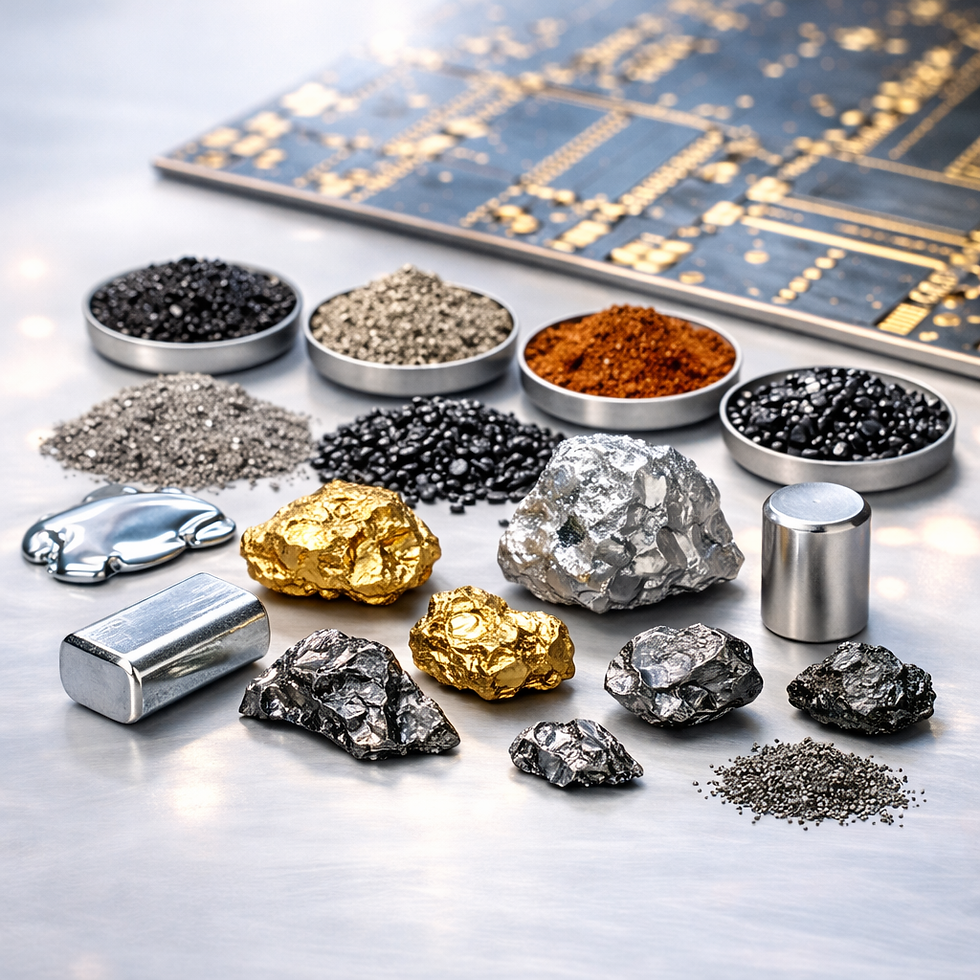
Some topics look like a niche subject at first glance. Technology metals & rare earths often fall into that category. In reality, they are far more than a specialist issue. They form part of the industrial backbone of the modern world.
When you think about wealth protection, gold and silver usually come to mind first. That makes sense. But alongside them, there is another asset class that works very differently. Not through centuries of monetary history, but through industrial necessity. That is exactly what this is about.
I want to show you why metals such as gallium, germanium, indium and hafnium have become so strategically relevant. And I want to explain how you can place this subject within a thoughtful long-term wealth structure, calmly and without exaggeration.
The key points at a glance
Technology metals are essential for digital infrastructure, energy systems, communications and defence.
Many of these metals are structurally scarce because they are often produced only as by-products of other mining processes.
Global processing capacity is heavily concentrated, especially in China.
Physical ownership works very differently here than it does with gold and requires proper storage and acquisition structures.
This asset class can be interesting as a strategic addition, but not as a replacement for a solid foundation.
Why technology metals & rare earths matter so much
If critical supply chains for semiconductors, fibre optics, medical technology or advanced energy systems suddenly stall, the effects are not limited to industry. Entire economies feel it. That is why technology metals have moved so sharply into focus.
And I do not just mean a handful of specialty metals. I also include rare earths as part of this broader category. These are raw materials without which many modern systems would simply stop functioning. No sophisticated communications, no high-performance electronics, no advanced sensors, no energy transition in its current form.
That is the key difference compared with classic precious metals. Gold and silver are primarily associated with wealth preservation, historical monetary stability and financial protection. Technology metals, by contrast, derive their relevance from industrial necessity. Their value proposition is tied to the fact that they are difficult to replace in critical applications.
Which metals are we talking about?
A few examples make the picture clearer.
Germanium
Germanium is used in electronics, fibre-optic cables and infrared sensors. In fibre optics in particular, it plays an important role because it supports extremely fast data transmission. That makes it highly relevant for modern communication networks.
Gallium
Gallium is used in high-frequency circuits, LEDs and certain solar cells. In other words, it matters wherever efficient energy conversion and high-performance electronics are required.
Indium
Indium is closely linked to high-resolution LCD screens and touchscreens. Without indium, many of the displays you use every day would hardly exist in their current form.
Hafnium
Hafnium was also mentioned as an example of a strategically relevant technology metal. The main point is not to isolate each metal in theory, but to understand the broader pattern: these materials fulfil highly specific functions and cannot easily be substituted.
That is what makes them so interesting. These are not bulk commodities. They are functional key materials.
The real bottleneck: supply cannot simply be expanded
This is the point many people underestimate.
Metals such as gallium and indium are often not mined in standalone operations. They occur as by-products in the extraction of other metals, such as zinc, lead or aluminium. That may sound technical, but it is crucial to understanding the market.
If demand for gallium rises, supply cannot simply be doubled at the press of a button. These markets do not respond that way. Availability depends on the production of other raw materials entirely.
Put simply, supply is structurally inflexible. Industry may need more, but production cannot be ramped up as easily as many assume.
That is where the bottleneck appears. When rigid supply meets rising demand, strategic importance increases automatically. Not just economically, but politically as well.
Why geopolitics matters so much here
Once a small number of actors control critical parts of a supply chain, the issue stops being just about market pricing. It becomes a question of power.
China in particular has built up substantial dominance in technology metals and rare earths over recent decades. And the key point is not only mining output. What matters even more is processing capacity. Between “metal comes out of the ground” and “metal is usable for industrial applications” lies a highly specialised chain of extraction, refining and preparation.
If that chain is concentrated in one country, dependency follows. And that dependency has become more visible in recent years. Export controls on metals such as gallium and germanium have shown how quickly these decisions can affect prices and unsettle industrial markets.
At that stage, we are no longer speaking only about free markets. We are talking about strategic raw-material policy. Europe and the United States have recognised the issue.
Legislative and industrial initiatives aim to improve recycling, diversify supply chains and build new capacity. The difficulty is timing. These processes take years, sometimes decades.
Mines, processing plants and refining infrastructure do not appear overnight. Until that gap narrows, supply remains fragile.
What this means for you as an investor
At this point, one principle matters most to me: true security lies in physical ownership.
If you access this market through shares, mining companies or complex financial products, you are never investing only in the metal itself. You are also investing in management decisions, political frameworks, legal jurisdictions and the broader stability of the financial system. That may be legitimate, but it is a very different risk profile.
Physical technology metals are different. Here, the focus is the asset itself. You are not buying a corporate promise. You are acquiring the raw material directly. That distinction matters.
At the same time, it is important to stay realistic. This asset class is not simple. It does not work like buying a few gold coins. Acquisition, purity, storage and resale are much more specialised.
Physical ownership comes with specific requirements
Technology metals are not typically stored at home in a safe next to gold and silver. There are good reasons for that.
First, purity matters. These materials need to be held in a form and quality that later remain acceptable for industrial buyers.
Secondly, storage matters. Professional high-security bonded warehouses play an important role in preserving industrial standards, documented provenance and later marketability.
Thirdly, resale matters. Any later exit to industry also needs a proper structure. Anyone entering this asset class should think beyond the purchase and consider the whole chain from the outset.
That is why this topic requires careful guidance. Not to make it sound complicated, but because avoidable mistakes can become unnecessarily expensive.
Who this may suit
I do not see technology metals as a fashionable short-term trade, and certainly not as a day-trading instrument. The approach is far too strategic for that.
This asset class may be suitable if you already have a solid core in place and want a measured allocation that is not driven by conventional financial logic alone, but by real industrial necessity.
In that context, the idea can make sense: not only protection through established precious metals, but also a modest, well-structured exposure to raw materials that are indispensable to key future industries.
The important point is not to buy from excitement or scarcity narratives. Buy only if you understand the structure. This market is less transparent than the gold market, and that is precisely why clarity matters.
What matters in the end
Technology metals are part of the backbone of the modern world. Their importance is rising, supply is often inflexible, and control is concentrated in relatively few geopolitical hands. That is what makes them strategically interesting.
At the same time, this asset class requires more care than classic precious metals. Purity, storage, acquisition and exit all need to be considered properly from the start. Any personal tax or legal questions should always be reviewed with your tax adviser or legal adviser.
If you would like to explore technology metals in a more structured way, it is worth starting with a calm and well-grounded overview. If you want a practical next step, you can use the link below.
✅ Free e-book: Download your copy here for clear, practical guidance on:
the strategic role of technology metals in a changing industrial world
what matters when it comes to physical ownership, storage and structure
how to avoid expensive mistakes in selection, pricing and set-up
Note: This article is for information purposes only and does not replace individual advice or tax/legal review.
