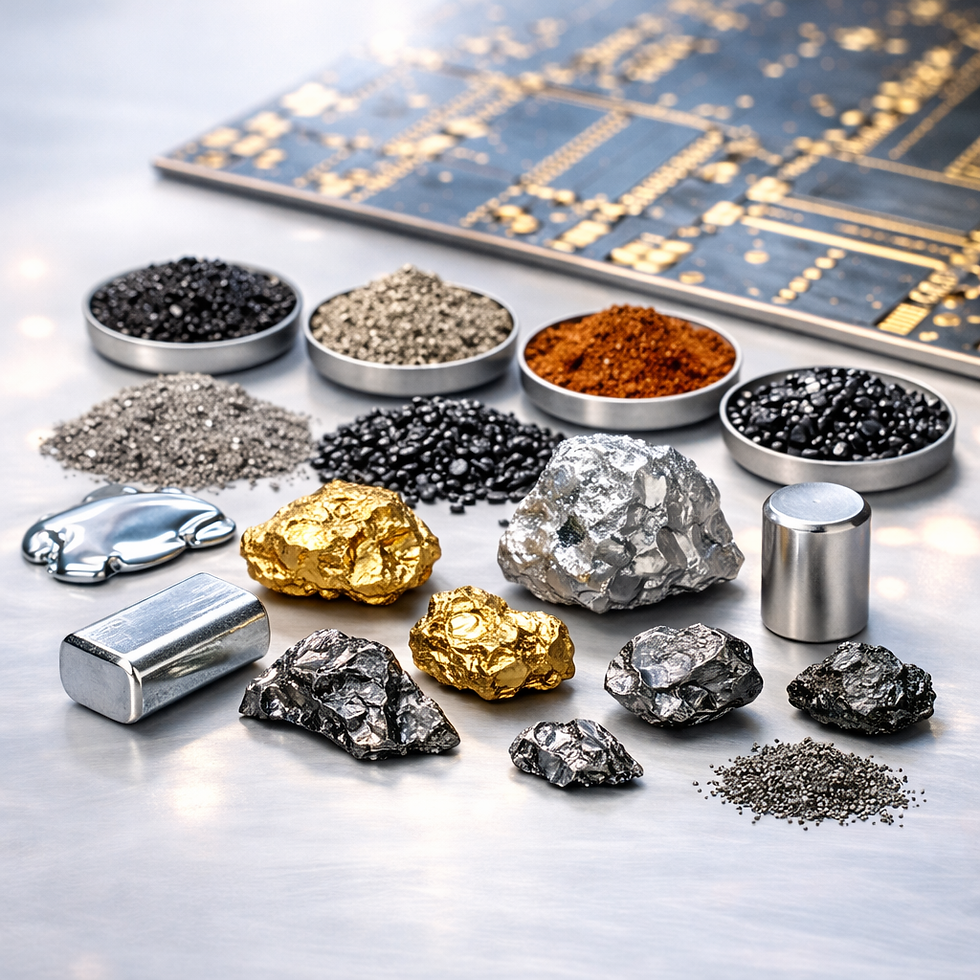
Physical Rare Earths: Why They Matter for Energy, Security and Wealth Preservation


There are certain raw materials hardly anyone talks about, even though modern systems would not function without them. Rare earths belong exactly in that category. At first glance, they sound technical, abstract and far removed from everyday life. In reality, they sit at the point where two major developments meet: the energy transition and military rearmament.
That is what makes this subject so important. If you want to understand which materials are likely to become more strategic over the coming years, rare earths deserve a closer look. This is not a passing trend. It is about the industrial foundation of modern technology – and about the role physical ownership can play in a carefully structured portfolio.
What matters most in this context
Rare earths are key materials for wind power, electric mobility and modern defence systems.
Elements such as neodymium, praseodymium, terbium and dysprosium are particularly important.
The market is shaped by highly concentrated processing capacity, especially in China.
Rising demand and limited supply create a structural tension in the market.
For safety-oriented investors, physical ownership follows a different logic from shares or funds.
What rare earths actually are
Rare earths are a group of 17 elements. The name is slightly misleading, because they are neither especially rare in the strict sense nor ordinary “earths”. What matters is something else entirely: they have properties that are indispensable in modern high-performance systems.
Where other technology metals are often linked to communication or semiconductors, rare earths are primarily about physical force. More precisely, they are about magnetic performance in a compact form. That is exactly what makes them so valuable in many applications.
If a modern fighter jet cannot operate without certain critical materials, and an offshore wind turbine cannot run efficiently without large quantities of them, that tells you very clearly what this is about: not theory, but industrial reality. According to the described classification, modern F-35 fighter jets contain more than 400 kilograms of a raw material that is essential for these systems, while offshore wind turbines require these materials on a scale measured in tonnes.
Why permanent magnets are the real core of the story
If you want to understand the economic relevance of rare earths properly, you need to focus on four elements: neodymium, praseodymium, terbium and dysprosium. These materials make it possible to produce permanent magnets with exceptionally high performance density.
These magnets are far stronger than conventional iron-based magnets. At the same time, they require less space and less weight. That is where their strategic value comes from.
Modern systems are expected to be powerful, compact, reliable and efficient. Without high-performance permanent magnets, that becomes difficult in many sectors.
This is especially true for electric motors. A large share of modern electric vehicles use synchronous motors based on permanent magnets because they offer high efficiency and strong power density. As the automotive industry moves further towards electric mobility, demand for these elements rises automatically. That is not a vague assumption. It is the logical consequence of the underlying technology.
The energy transition is not just about targets – it is about material
There is a great deal of discussion about climate targets and reducing CO₂ emissions. What is often overlooked is this: those targets require an enormous physical base. The energy transition does not happen through political declarations alone. It requires real hardware. And that hardware requires raw materials.
Offshore wind power makes this particularly visible. Installations in harsh marine environments have to operate reliably and with low maintenance over many years. That means using powerful generator systems – and therefore large quantities of rare earths.
This is the point at which the topic becomes especially relevant for investors. As long as political momentum continues behind wind power and electric mobility, the material question remains. If these sectors are meant to expand, demand for the required key materials remains structurally high. That is the logic behind it.
The second force driving this market: security policy and rearmament
Rare earths are not only relevant for green transformation. They are also a central building block of modern defence and security systems. In a world of growing geopolitical tension, this aspect carries even more weight.
Drones, precision-guided weapons, radar and sonar systems, laser rangefinders and other highly complex technologies all rely on compact, durable and dependable components. Rare earths make it possible to reduce component size while maintaining performance under extreme conditions.
At that point, this becomes more than a raw materials issue. It becomes a matter of industrial and national sovereignty. If Western states want to build or modernise defence systems, yet remain dependent on a systemic rival for such a crucial material, the issue is not merely commercial. It is strategic.
The real bottleneck is not only mining, but processing
When people think about raw materials, they often start with mines. With rare earths, that is not enough. The decisive question is not only where the material is found, but who can chemically separate it, refine it and turn it into industrial-grade quality. That is where the real bottleneck lies.
Mining, separation and processing of rare earths have for decades been dominated to a large extent by China. Efforts in Australia, North America and elsewhere to build alternative structures are serious and ongoing. Yet new mines, and especially new processing facilities, do not appear within months. These projects take years, sometimes a decade or more.
That means even if the West acts decisively today, the scarcity of processed, high-purity rare earth elements is likely to remain an issue for the foreseeable future. And that is exactly where the gap between rising demand and limited supply becomes so important.
What that can mean for your wealth structure
This is where the investor’s perspective comes in. If a raw material is indispensable to industry, if its demand is driven by two major long-term trends, and if supply remains heavily concentrated, then one reasonable question follows: how can this be approached in a structured and sensible way?
One route would be mining shares. That is possible. But then you are not only buying exposure to the raw material theme. You are also taking on business risk: management failures, political intervention, environmental regulation, potential shutdowns and uncertainty in the producing country.
The other route is physical ownership. For safety-oriented investors, that has a very different quality. If you hold physical raw materials, you hold a real asset that cannot simply be created at will. You are not dependent on a company balance sheet, but on the material itself.
That point matters. This is not about short-term speculation. It is about long-term positioning. And it is about complementing a traditional foundation of gold and silver with critical components of the industrial future.
Why access is not straightforward for private investors
In theory, physical ownership sounds simple. In practice, rare earths are far more demanding than classical precious metals. It is a question of purity grades, industrially accepted forms and the right storage logic. These materials are not simply standardised coins kept in a drawer.
Storage matters as well. If those materials are later meant to re-enter the industrial cycle, the structure has to support exactly that. That is why professional duty-free storage plays such an important role in this field.
For private investors and entrepreneurs, access to this world has traditionally been difficult. That is precisely why a clean structure matters: transparent processes, clear ownership, comprehensible storage and a concept built on substance rather than marketing.
What matters in the end
Rare earths sit at a strategically important intersection. They matter for the energy transition, electric mobility and modern security systems, while supply remains constrained by complex processing and concentrated market power.
At the same time, this asset class requires more care than classic precious metals. Purity, storage, acquisition and structure all need to be considered properly from the start. Any personal tax or legal questions should always be reviewed with your tax adviser or legal adviser.
If you would like to explore whether rare earths and other technology metals could make sense in your wealth structure, it is worth starting with a calm and well-grounded overview. If you want a practical next step, you can use the link below.
✅ Free e-book: Download your copy here for clear, practical guidance on:
why rare earths and other technology metals matter in a changing industrial world
what matters when it comes to physical ownership, storage and structure
how to avoid expensive mistakes in selection, pricing and set-upup
Note: This article is for information purposes only and does not replace individual advice or tax/legal review.